
Conservation Hours, attributed to members of the Recycling Committee and Facilities Services, are anticipated to reduce the College’s carbon footprint by 1.25% and the college’s use of natural gas by 5% by 2020. The project was initiated after the release of Bryn Mawr’s Climate Action Plan and began with a student-approval survey in the 2012-2013 academic year. In the survey, students were asked about the current temperature of their dorms, their preferred temperature, and the hours when they are least likely to be in their dorm room. While student opinions were greatly considered during this process, and the conservation hours are an effort of everyone living on campus, the project was not as simple as turning down the thermostat. Although the dormitory buildings are visibly beautiful, their historic construction created some ugly obstacles. For some dormitories, just a handful of rooms determine the temperature of the heater.

Photo of a conservation symbol around campus reminding students to conserve energy.
After some trial and error to ensure that everyone remains comfortable in their rooms, each dormitory now conserves energy by decreasing the heat from 70 degrees to 67 degrees between the hours of 11:00 a.m. and 3 p.m. This time slot is a result of the student-approval survey, and it signifies a time where students feel they are not in their room because of classes and other responsibilities on campus. However, the students and Facilities Services’ members did not stop there. The project has expanded to administrative buildings, which now conserve energy throughout the night while there are no workers present.
Administrative buildings commit to conserving energy from four to twelve hours per night. Benham Gateway, Schwartz Gym, Taylor Hall, Wyndham, Carpenter Library, the Health Center, Cartref Hall, Dolwen, Guild Hall, Human Resources, and the Ward Building have all pledged to turn down their heat in a manner comparable to that done in the dorms, typically from 70-72 degrees down to 68-70 degrees. Although many buildings do not have air conditioning, those that do also increase their cooling temperatures during the appropriate seasons to conserve energy.
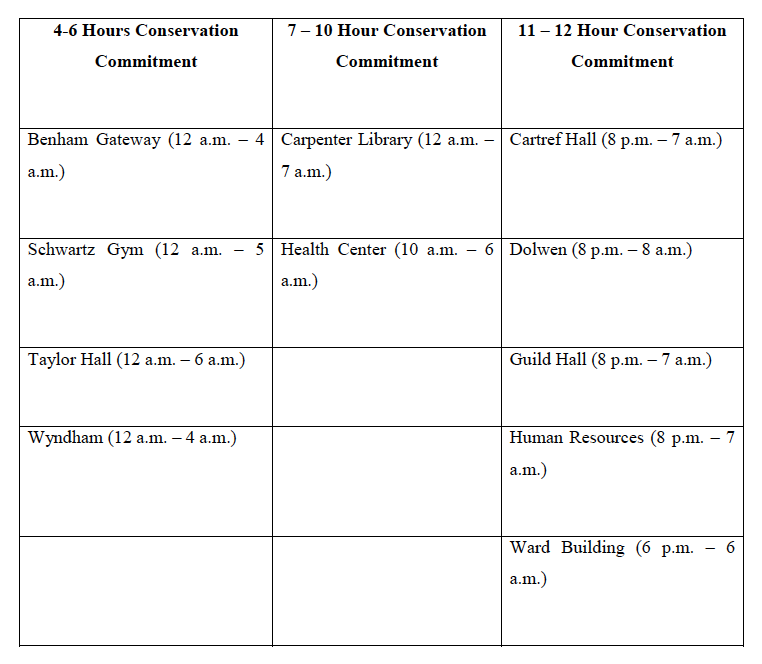
Source: Bryn Mawr College Climate Action Plan Update