
Composting was first introduced to the Bryn Mawr College community in the Spring of 2011 by the Environmental Studies Senior Seminar. Subsequently, during the Fall 2011 semester, the Sustainable Foods Committee, a committee of Bryn Mawr’s Self-Government Association (SGA), adopted the composting initiative as a major focus of the committee and worked in conjunction with Dining Services, and with the support of students and student groups like Bryn Mawr College Greens, to create a composting program on campus. On September 25, 2011, Bryn Mawr’s student body passed a resolution presented at Plenary by Sustainable Foods Committee representatives that established student support for the Sustainable Foods Committee and Bryn Mawr’s Composting Initiative.
Fall Plenary 2011 Resolution 2:
Composting Research and Development at Bryn Mawr
Presented by Daniele Arad-Neeman ’14 and Karen Leitner ’14 (SGA Sustainable Food Committee)
Whereas, Bryn Mawr has made a commitment to make practices on campus more sustainable and “green” by signing the President’s Campus Climate Commitment;
Whereas, all of our compostable food waste is currently incinerated with the rest of the college’s waste;
Whereas, this waste releases 9,108 lbs of carbon a year;
Whereas, there is significant student support for a composting program as demonstrated by surveys and research done in Erdman dining hall by the 2010-11 Environmental Studies Senior Seminar;
Whereas, Dining Services has expressed interest in working with the Sustainable Food Committee on composting in the dining halls but both lack administrative oversight and financial support;
Be it resolved, Bryn Mawr students support the efforts of the Sustainable Food Committee in their efforts to conduct research for the creation of a comprehensive composting program on campus.
Source: SGA Blogs – http://sga.blogs.brynmawr.edu/2011/10/01/fall-plenary-2011-minutes/
During the 2011-2012 academic year, the Sustainable Foods Committee held two Composting Trials in Haffner and Erdman Dining Halls, once in the Fall (November 15th, 16th and 18th) and once in the Spring (March 18th – April 1st). The November trial recorded an average of 325.86 pounds of compostable post-consumer waste in Erdman Dining Hall and 223.1 pounds of compostable post-consumer waste in Haffner Dining Hall. Preconsumer waste results (primarily food waste created in the kitchens) indicated room for improvement in composting practices, which the Sustainable Foods Committee hypothesized would occur as a full composting program was implemented and people were able to adjust their work routines.
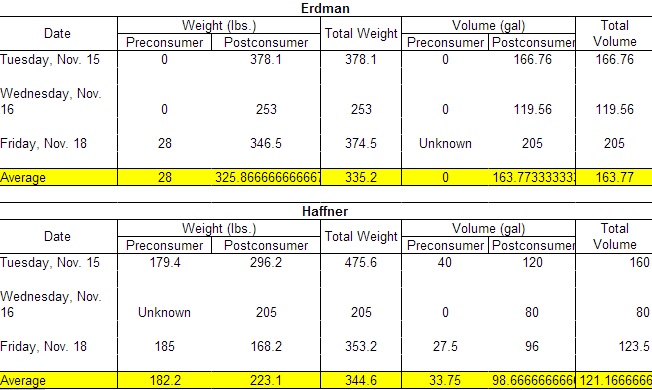
Source: Compostable Waste Measurement Results from Composting Trial November 15-16, 18, 2011 (Directed from Bryn Mawr Composting Initiative Facebook Group)
In the Fall of 2012, Erdman and Haffner Dining Halls began composting full-time with Philly Compost. In addition, a student group in the Fall 2012 senior conference course, Math Modeling and Sustainability, completed a final project analyzing the carbon emissions of trash pickup on campus before and after composting began. The project found that composting led to a decrease in the amount of waste put in the trash to be incinerated, thus allowing the college to reduce trash pickup to just three times a week from five. The project also found that annual costs for the college have increased by a small amount due to composting, however the college feels that the reduction in carbon emissions due to composting (19.65 tons per month) justifies the small increase in cost.
Wyndham Alumni House and Batten House now also take part in this composting program. Be sure to look out for signs in the dining halls with information on which food wastes can and cannot be composted!